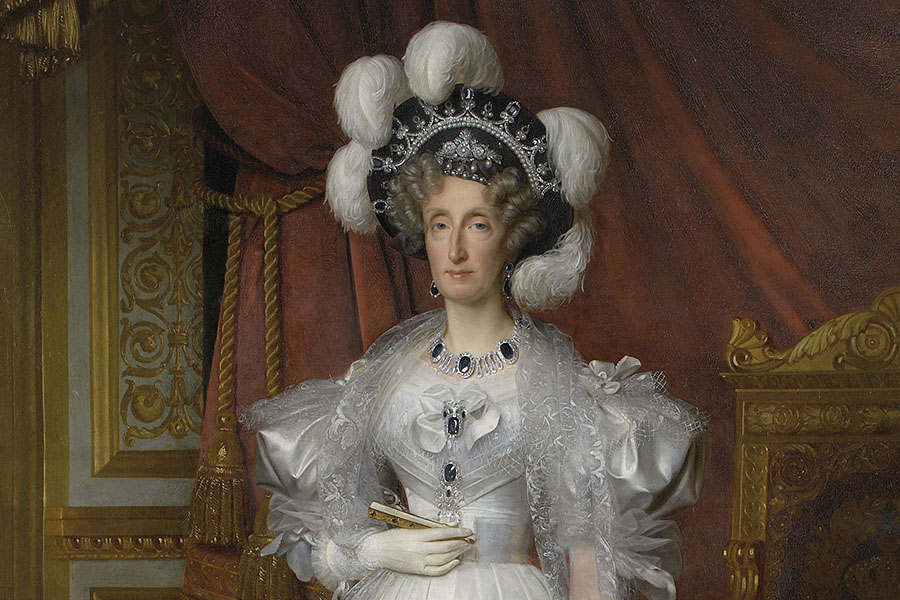
A royal life framed by exile and ceremony
Maria Amalia of Naples and Sicily lived a riverine life in Europe. She was born in 1782 at Caserta Palace near Naples, the tenth of eighteen children. Her world was crowns, alliances, flight, and rigorous ceremony, but she was famous for her quiet strength. I see her as a woman who kept together a large dynastic web with discipline, faith, and family love, not as a court ornament.
Her parents were Ferdinand I of the Two Sicilies and Maria Carolina of Austria. That alone made her part of Europe’s most powerful family network. Maria Amalia was part of Vienna, Naples, and Versailles’ imperial stream because her mother was Marie Antoinette’s sister. Her grandparents were Charles III of Spain, Maria Amalia of Saxony, Maria Theresa, and Holy Roman Emperor Francis I. Her crib was encircled by thrones.
Her childhood was difficult. French Revolution and Napoleonic era moved her family across borders like leaves in a storm. In 1789, she was engaged to French Dauphin Louis Joseph, who died young. Her family left Naples, traveled through Sicily and Austria, and returned, only to be uprooted again. Upheavals made her life difficult. She quickly realized that royal life was a tent on shifting ground.
Marriage, children, and the architecture of a royal household
In 1809, Maria Amalia married Louis Philippe d’Orléans, who later became Louis Philippe I, King of the French. The marriage was political, dynastic, and deeply meaningful. It linked the Bourbon-Two Sicilies line to the Orléans branch of the French royal family. She became Duchess of Orléans first, then Queen of the French in 1830, a title she wore reluctantly, almost like a cloak borrowed from history.
Their marriage produced ten children, and each child became a thread in a larger European tapestry. Ferdinand Philippe, Duke of Orléans, was the eldest and perhaps the most important dynastically. He married Hélène of Mecklenburg-Schwerin and became father of Philippe, Count of Paris. Through him, Maria Amalia became the grandmother of an heir who mattered deeply to the Orléans cause.
Louise became Queen of the Belgians through her marriage to Leopold I. Marie married Duke Alexander of Württemberg. Louis, Duke of Nemours, married Victoria of Saxe-Coburg and Gotha. Françoise died young, a sorrowful note in the family record. Clémentine married August of Saxe-Coburg and Gotha. François, Prince of Joinville, married Francisca of Brazil. Charles, Duke of Penthièvre, died at age eight. Henri, Duke of Aumale, married Princess Maria Carolina of Bourbon-Two Sicilies. Antoine, Duke of Montpensier, married Infanta Luisa Fernanda of Spain.
When I look at this family, I do not see a simple household. I see a network like an intricate clock, each gear turning against another, each marriage joining kingdoms, each birth carrying political weight. Her children connected France, Belgium, Spain, Württemberg, Brazil, and the Italian courts. Few royal mothers shaped such a broad dynastic map.
The queen who preferred restraint over spectacle
Maria Amalia was not a flamboyant queen. That is one of the most important things about her. During the July Monarchy, she lived with a kind of inward gravity. She preferred family life, religion, and charity to display. She was deeply pious and personally restrained. Reports often describe her as simple in habits and sincere in feeling. That simplicity mattered. In a court that could be all silk and mirrors, she was more like stone, steady and unadorned.
Her financial habits reflect this character. She received a large allowance, but she was known to give much of it away to the poor. One account says she gave away 400,000 francs out of 500,000 francs in private income. That figure feels almost mythic, yet it captures something real about her reputation. She was not remembered as a collector of luxuries. She was remembered as a dispenser of care.
As queen, she helped steady a monarchy that was always vulnerable. Louis Philippe ruled after the July Revolution of 1830, and Maria Amalia became Queen of the French, not Queen of France. That title mattered. It reflected a constitutional monarchy, not an absolute one. She occupied this role with reserve, aware that royal legitimacy in the nineteenth century was fragile and often contested. Her presence gave the regime a familial face.
Grandchildren and the widening circle of influence
Maria Amalia’s family continued beyond her children. Her descendants expanded the Orléans line across Europe. They included Philippe, Count of Paris, who continued the Orléans claim; Leopold II of Belgium, whose daughter Louise became a Belgian royal; and others who became royals in Mexico, Bulgaria, and Spain.
Dynasties persist beyond crowns, therefore this mattered. They survive marriages, inheritances, and memories. Maria Amalia’s grandchildren were like branches from a Naples-rooted tree added to the European woodland. Her family was not little. It was alive strategically.
Exile, aging, and memory
The year 1848 shattered the French monarchy. Revolution drove Louis Philippe from the throne, and Maria Amalia left France with him. The family went into English exile. After her husband’s death in 1850, she lived quietly until 1866, when she died at Claremont House in Surrey at the age of 83. She requested burial under the title Duchess of Orléans, which says much about her identity. Even after a crown, she remained attached to the family name rather than the state.
A town in France, Amélie-les-Bains, was renamed in her honor in 1840. That kind of naming is a small monument, but it tells us how she was seen in her own time. She was not a warrior queen or a political firebrand. She was a royal mother, a consort, and a stabilizing presence. Her memory survives in the children she raised, the alliances they formed, and the long echo of a family that crossed borders like a banner in the wind.
FAQ
Who was Maria Amalia Of Naples And Sicily?
Maria Amalia Of Naples And Sicily was a Bourbon princess who became Duchess of Orléans in 1809 and Queen of the French in 1830 after marrying Louis Philippe I. She was born in 1782 and died in 1866.
Who were her parents?
Her parents were Ferdinand I of the Two Sicilies and Maria Carolina of Austria. Through them, she was tied to several major European royal houses.
How many children did she have?
She had ten children. They included Ferdinand Philippe, Louise, Marie, Louis, Françoise, Clémentine, François, Charles, Henri, and Antoine.
Which of her children became especially important?
Ferdinand Philippe was especially significant because he was the Duke of Orléans and father of Philippe, Count of Paris. Louise became Queen of the Belgians. Henri became Duke of Aumale, and Antoine became Duke of Montpensier.
What was Maria Amalia like personally?
She was known for piety, modest habits, and charity. She preferred family life and private duty to public spectacle. Her character was often described as restrained and sincere.
Why is she historically important?
She mattered because she linked the Bourbon-Two Sicilies and Orléans lines, helped shape the French royal family of the July Monarchy, and became the mother of children who married into several major European dynasties.
Where did she spend her later years?
After the revolution of 1848, she lived in exile in England. She died at Claremont House in Surrey in 1866.